Voices
Understanding Solidarity with LGSM
Ray Goodspeed, founding member of Lesbians and Gays Support the Miners, talks to Act Build Change about solidarity work in 1985 and 2025.
Jemima Elliott | 9 Dec 2025
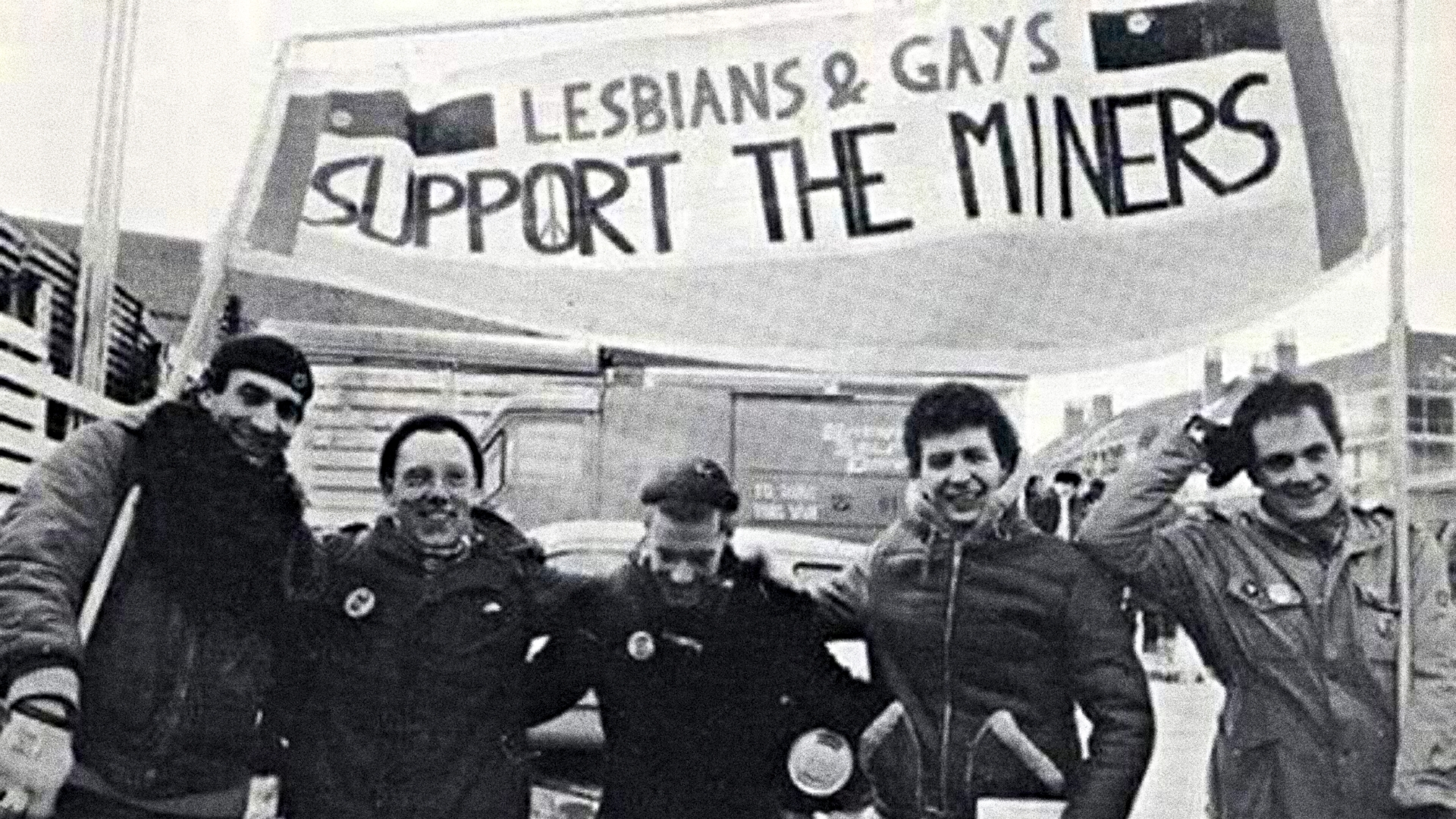
From left-to-right: Jonathan Blake, Mike Jackson, Ray Aller, Colin Clews and Ray Goodspeed – at a picket of a power station in Willesden, 1985.
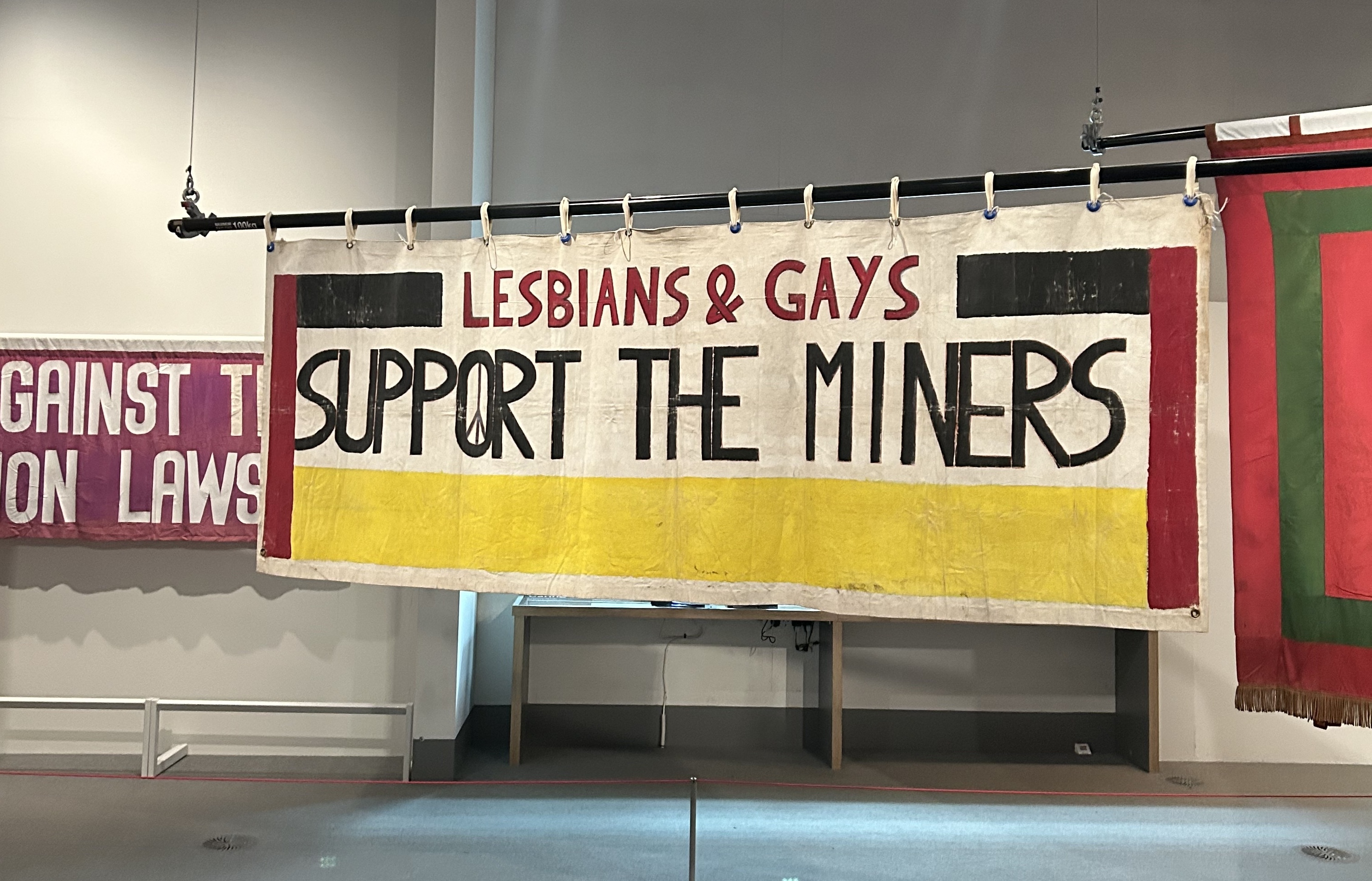
During the Miners’ Strike of 1984-85, solidarity groups organised across the country to provide aid to striking miners and their families. One of the most famous of these groups was Lesbians and Gays Support the Miners (LGSM) who fundraised in the queer community for the strike efforts. Their work and the relationship they built with the miners of the Dulais Valley, South Wales, was dramatised into the film Pride in 2014. The funds raised by LGSM ensured the miners of Dulais and their families had food and heating and were able to sustain the strike for a year.
As a young queer and socialist Welsh woman, the film moved and inspired me, it pushed me forwards in my organising and is a comfort to me in times of struggle. I imagine it has done the same for many other organisers too. Talking with Ray Goodspeed, a founding member of LGSM, he described many experiences and scenes that felt very familiar to me. It reminded me that no matter what Hollywood may make them seem like, movements and successful organising is really about the gritty, perhaps mundane, everyday acts of commitment. Commitment to our relationships with each other, commitment to the cause and the goal, commitment to showing up everyday in whatever way we can, commitment to the world as it could be.
So what can we learn about solidarity and movement building from LGSM today? We spoke to Ray about his experiences and the lessons he learned then and since.
Organising with LGSM
Ray came out as gay to his parents in 1983 and was already an active member in union organising and was collecting money for the miners before LGSM began. When Ray saw an advert in the local paper for a meeting at an organiser’s house, he went along. LGSM quickly grew from 11 people at the first meeting to an average of 30 attendees every week, meaning they had to move from Gay’s the Word Bookshop to a room above a local pub. In this room many queer friendship groups and organisers from a broad range of leftist politics melded together with one mission: to support the striking miners.
Ray explains how the group brought together not only experienced political organisers, but also a network of people who weren't politically active. Many of the new organisers saw the strike as a civil rights issue and saw parallels between how the state treated the queer community and the miners. ‘Those people were crucial to making LGSM effective,’ Ray says, ‘they brought so much joy to the group and we couldn’t have held the Pits and Perverts fundraising concert [that raised thousands for miners and their families in South Wales] without them. They brought new creativity and camp chic.’ Many of these members had fled to London searching for freedom and liberation, and continued to organise after the strike.
Ray laughs while remembering collecting money for the miners. ‘It improved my social life!’ he recalls. ‘I made myself go out to gay pubs and clubs more than I would have done. It was an excuse to chat to gay men.’ When looking back at campaigns like the 1984-5 Miners’ Strike and LGSM, we can often take too serious a lens and forget the reality of everyday life and everyday organising where there are jokes, laughter, friendship and perhaps, in this case, the occasional flirt.
In meetings you were only permitted to speak if you’d brought money you had collected - to have influence on decisions you had to be active in the day-to-day organising of the group and be on the streets to have something concrete to contribute to the miners’ struggle. ‘No one was there to just air their opinions or just criticise for the sake of criticism,’ says Ray, ‘it was action-based and you had to bring money even if you did other jobs like organising events, otherwise forfeited your right to speak. You had to materially contribute.’ This is a lesson any organising group can adopt and bring in - voice should be given to those who actually get stuck in and are active on the ground rather than people who only want to complain or critique without doing any of the work themselves. In the case of LGSM, ‘if you’re not prepared to do practical stuff for the miners then you’re not welcome.’
Learning the meaning of solidarity
‘Being invited to South Wales was extraordinary,’ Ray says, ‘we didn’t think they would reply to us let alone invite us. We were so demonised by the press and by politicians - in the same way trans people are now. There were 27 of us visiting from London on that first trip - it wasn’t the minibus portrayed in the film,’ Ray remembers, ‘27 queers rocking up to a small town in the Welsh Valleys. The first night in the welfare hall nobody walked out, we were given a round of applause and treated well. Many of us didn't get that kind of reception back in our home towns. Once we started chatting to people it came really clear how much we had in common, no one tiptoed around our sexuality, they were curious. We talked about all sorts of things - our lives, the strike, their kids. It was such a moment of joy and unity, it’s where it dawned on me that we were part of something special. I remember my friend David saying to me “Oh god what have we done, this is incredible” and Mike Jackson saying you’d “have to kill him to stop him supporting the miners” after that. To get that kind of solidarity back was so unexpected and so humbling.’
‘Our job wasn’t to tell the miners what to do’ explains Ray, ‘what right did we have to do that even if we thought differently to them? There’s a difference between having a general political analysis and saying your solidarity is conditional on adopting that political analysis. We support you anyway. Solidarity means just that - once the decision has been made, once the die has been cast and you’re actually in action, you don’t split the fight or split the movement, you work together toward the same goal. That’s why any attempt to turn LGSM into a long-term political group would have floundered because we had nothing in common except our support for the miners and being queer. Our group had one goal and we had to stick to it.’ Knowing when your campaign has come to an end, even if it has been defeated in that current iteration, is a valuable skill to have. It doesn’t mean the fight is over, but that that campaign group has run its course and needs to change or regroup.
Challenges to overcome
Any organising work has its challenges, and conflicts arise all the time. It’s how we work either to solve them or to live with them that matters. With an average of 30 people but sometimes up to 50 at every weekly meeting, many of them tried and tested organisers from across the political left, ideological conflicts at LGSM meetings were inevitable. ‘We fought like cats and dogs,’ said Ray, ‘but we were united completely around the miners. We couldn't allow our ideological disputes to interfere with the main goal of supporting the strike. It wasn’t worth splitting the group and weakening our impact.’
‘We could have our arguments - and we did - but if you supported the miners you were in,’ Ray recalls. ‘For example, very little of mine and Mark Ashton’s politics gelled together - beyond the fact that we were both socialists I didn’t agree with his politics, but I just loved the man. Our arguments were softened with campness and often solved in the pub after meetings. Ultimately, we were a gaggle of gays and lesbians supporting the miners, we were already unpopular enough, we didn’t need to split and make it worse. However bad it got, [the miners] had to win. If they didn’t give up, neither could we. Nobody from LGSM drifted away - all while the miners were solid, so were we. In the pits we supported, hardly anyone went back to work.’
‘Something we didn’t know at the time was how much of a challenge not having the internet or mobile phones or even a photocopier was. Now, agendas and minutes can be sent in seconds, but in 1984 Mike Jackson would write up agendas, stencil them, cycle around London to deliver them to everyone and post the rest. Everything had to be done either face to face or by letter - it took a lot more time and we had to be very specific about meeting times and places, it was all planned in fine detail.’ The lack of technological communication may have taken more time than communication takes us now, but it has its strengths. It meant that relationships, communication and commitment became a responsibility. In the digital age we have mass emails and newsletters, transactional social media likes and shares, which can be good for spreading awareness but creates a false sense of community and relationships. When you have to make the effort to show up regularly in person, commitment to the movement is stronger.
Impacts
Even though the strike was unsuccessful in its demands, it would not have lasted so long without groups like LGSM fundraising for food, clothes, and to cover household bills. The strong influence of unions over the Labour Party at the time meant that, as a result of this newfound comradeship and after long-term efforts by queer Labour organisers, the NUM pushed gay rights onto the agenda of the mainstream left at a time when the queer community were being demonised. LGSM brought many queer people into organising when they’d previously had no experience as well as catalysing the political journeys of people like Siân James, a miner’s wife and member of the Neath, Dulais and South Wales Valleys Miners’ Support Group who became the first woman MP of Swansea East in 2005.
Solidarity work in 2025
The core message that Ray conveyed to us was the importance of unity and not fracturing our goals once we have decided on a course of action. ‘You see, solidarity is all we’ve got,’ Ray told us. ‘From the perspective of the left, we’ve got nothing - the ruling class have got all of the money, the press, they can employ dozens of people in think-tanks to churn out nonsense - but all we’ve got is unity and solidarity. If we damage that, then we’re going to lose. There’s a need in every campaign for an attitude of “we’ve made a decision, let’s go for it now and don’t mess around, don’t constantly fight”.’ Ray continued: ‘You need a group of people you can really trust, even if you have disagreements with people you need to trust them to be able to commit to your campaign and that they will do what they say they will do. If we are fractured we lose our only advantage.’
When reflecting on the necessity of unity, Ray highlights the division over trans rights in both the broader queer community and wider left: ‘People accuse trans people and people who speak out against transphobia of ‘splitting the movement’ but who’s splitting the movement really? Trans people are just being themselves, it’s cis queer people’s failure to support them that is splitting the movement [for queer liberation].’ Ray called for more action on trans rights, louder and bolder direct action and show of community strength, highlighting the work of youth trans liberation group Trans Kids Deserve Better.
‘Hardly anyone thought the miners would support us as queer people,’ Ray recounts, ‘But then they did! Though we would have supported the miners even if they didn’t support us because they needed to win. Even if they were homophobes to the last person we would have supported them anyway because they had to win for the whole working class movement more generally. If they didn’t win the entire labour movement would be crushed, and of course they lost and the entire labour movement had a significant setback and for a good 10-15 years after gay people also had a terrible time with section 28 and the AIDS epidemic.’ We reflected on how the phrase ‘Why should you/we support them if they won’t support you/us?’ - frequently used during the miners’ strike - is now often used as a counter-argument to explicitly queer Palestine and migrant solidarity groups, citing homophobia as a reason not to support Palestinian and migrant justice. Our struggles and fights for justice are all connected. Just as support for the miners had to be unconditional to be successful, so too does our support for Palestinians.
In our current political landscape, the far-right are actively pitting working class, queer, and migrant communities against each other, despite that these are not distinct or binary categories and how much we have in common. Ray’s emphasis on the importance of maintaining unity and solidarity as a key element of successful organising is perhaps more important than ever. We need to reconsider how we build people power in the face of the crises we are up against, most of which stem from division and inequality, and how we can move beyond defensive actions in reaction to the far-right and instead move on the offensive for community power.