Voices
Brick by Brick – How Young People are Taking Action Against Wealth Inequality
Maya Mackay shares how The Advocacy Academy’s latest campaign makes tackling a systemic issue achievable.
Maya Mackay | 16 Nov 2026
Wealth inequality is a huge systemic issue, which when looked at as a whole, is overwhelming and intimidating. Yet, this is the issue we decided to take on when we came together at The Advocacy Academy. We had to ask ourselves – how could we as young people even begin to make change on such a large level?
From The Big Vote to Tax the Rich
The Advocacy Academy (TAA) is a grassroots youth organisation in the heart of South London, providing a space for young people to come together, explore the issues affecting our communities, and turn our concerns into collective action. As a member since 2024, I have seen first hand how the principle of ‘community’ cements the core and framework of our organisation; every campaign is fuelled by a shared vision, mutual understanding and empathy.
Our most recent campaign started with listening to what makes our community angry and, after 100 conversations understanding the issues we wanted to campaign on, 80 young people came together for ‘The Big Vote’ in December 2025. Participants voted on a selection of campaign proposals that resonated most with them and would have the most widespread impact. What emerged was an opportunity to transform individual concerns into collective priorities.
Seeing so many young people travel across London to take part was a powerful experience, it was the biggest gathering of people I had ever seen in the Liberation Centre. Although social media is an important way to engage young people with political and social issues, there was something so singular about having fervent young voices reverberating around the same physical space, something that we often fail to facilitate in our society. The overwhelming atmosphere of respect and understanding was palpable. We could properly listen to one another, think freely and critically and explore complex issues to work towards a shared understanding. The event ended with a shared meal, a comfortable space not only to encourage discussion but to celebrate the unity that we had already achieved.
The decision between three proposed campaign options was made with young people moving between corners of a giant triangle in the room to place our votes, before further deliberation, debate and the space to change our mind in real time. This methodology for democratic decision-making was designed by members, making sure we all had an opportunity to voice questions and have a meaningful say on what comes next. Through this process, The Big Vote resulted in an overwhelming majority excited for the launch of our Tax the Rich campaign in the new year.
But a broad political demand is only the beginning. The next challenge was to turn the idea of taxing extreme wealth into a specific, achievable campaign.
Turning ‘Tax the Rich’ into ‘Fines by Fortune’
Members began with at least eight different ideas for specific policy changes which could begin to tackle wealth inequality. We used scoresheets to assess which of these we wanted to take further, again landing with three specific campaigns to develop through storytelling, mapping power and researching evidence to inform our policy demands. After hearing each campaign pitch and charting how worthwhile and winnable each would be, we voted using the same methodology of The Big Vote, moving and deliberating in the physical space. This voting spanned two weeks as young people in the room decided slow and thoughtful decision-making should be our priority, and fines based on wealth gained more votes both weeks. Now we knew we had an opening to act.
In June 2026, as we were developing these campaign ideas, the Financial Conduct Authority (FCA) - the UK regulator responsible for overseeing financial services firms and markets - opened a public consultation on potential changes to how they make enforcement decisions and calculate financial penalties. This provided us with an opportunity to challenge how the imposition of financial penalties reinforces wealth inequality. While people on lower incomes can face fines that place a significant strain on their finances, wealthy individuals and large businesses may be able to absorb substantial penalties without changing their behaviour. When a fine is small in comparison with an organisation’s wealth or the profits gained through misconduct, it risks becoming little more than a cost of ‘doing business’.
In response, TAA developed a proposal for a more proportionate system. Under this approach, fines would reflect the financial circumstances of those responsible, including the resources of wealthy individuals and corporations, rather than relying solely on fixed amounts. This would contribute to our wider goal of challenging extreme wealth inequality and the unequal consequences of financial rules - creating a brick on which we could build larger wins.
As the campaign developed, we began to think more carefully about how to communicate the issue to both decision-makers and our local community. We organised a group meeting where three name proposals were brought forward: ‘Fines by Fortune’, ‘Penalties Not Pennies’, and the original ‘Tax the Rich’. Again we voted by movement across the room as a practice of consent-based decision-making. We decided to eliminate ‘Penalties Not Pennies’ due to the potential ambiguity of the message and ‘Tax the Rich’ was deemed too confrontational and simplistic.‘Fines by Fortune’ was born.
The new name captured the injustice at the heart of the campaign: the contrast between those who struggle to afford a fine and those for whom a penalty is barely felt. It also made our specific demand clearer. Rather than suggesting that our campaign was about targeting ordinary people or the middle classes, Fines by Fortune directs attention towards extreme wealth, large businesses and a system in which financial penalties can have vastly different consequences depending on who pays them. Changing the name was more than a branding decision. It helped us articulate the problem more precisely and connect our broader ambition for wealth equality to a concrete regulatory change.
Taking the campaign into the public arena
Research by the Bureau of Investigative Journalism has highlighted a significant decline in FCA fines, underlining the importance of scrutinising how financial penalties are used. The consultation offered TAA a practical opportunity to put forward a more just alternative and call for a system in which penalties are more closely aligned with the resources of those responsible.
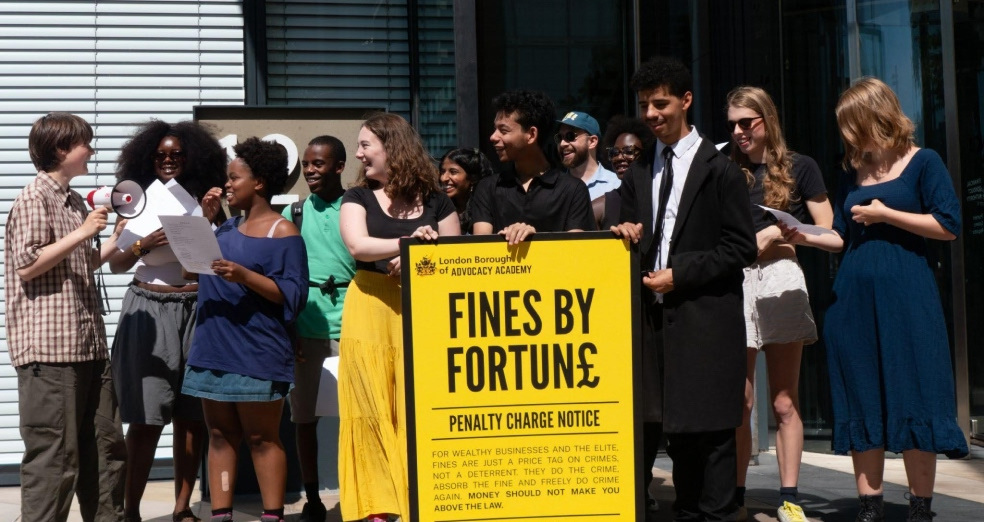
On 8th August, we took the campaign to the FCA’s headquarters. We displayed a giant yellow penalty notice to make the wealth disparity behind current fining practices visible to the public, and delivered a handwritten response to the FCA’s consultation.
Since launching the campaign, we have also produced social media videos and received coverage from outlets including FT Adviser and Brixton Buzz. Alongside this public-facing work, we have continued to organise meetings, including hybrid sessions at the Liberation Centre in Brixton, to involve more young people aged 16–25 in the campaign and future actions.
As we continue to grow our campaign, we move beyond the walls of the Liberation Centre, to build our base with the young constituents of Hackney South and Shoreditch as we work towards securing a meeting with their MP, Meg Hillier, who chairs the Treasury Select Committee which oversees the FCA. Building relationships between our London Boroughs will centre the experiences of young people angry about wealth inequality and prepare our movement for further action.
What next?
Our work is far from over. We plan to continue holding monthly strategic actions to maintain public attention, build community involvement and create further opportunities for young people to participate.
The Big Vote showed us the value of creating a space where young people could discuss the issues that matter to them and decide together what to do about them. When people feel their voices are heard, they become more invested in the campaigns that follow. Developing ‘Fines by Fortune’ showed us how a broad concern, such as wealth inequality, overwhelming on its own, can become a more focused and winnable campaign with a specific demand and a clear opportunity for action.
This campaign has reinforced that campaigning is not just about a single moment of visibility, it is the cultivation of something much more profound that is the key to organising, and that makes TAA what it is: a human understanding that lies at its foundation. TAA is a space for growth — intellectually, emotionally and personally. In a society where we are often conditioned to avoid the discussion of such social issues due to fear of judgement or conflict, the Liberation Centre shows us that being able to have such discussions is not just crucial to change, but also to understanding our complex social systems. From the routine community meals that we share, the activities, open events and campaigns that involve the integration and collaboration with many young people and local organisations, the way TAA functions sustains its positive energy, self-reflexive environment, and open-minded curiosity. It is within this space that issues are no longer the burden of those most affected, but become part of the general and overarching desire for change, in which everyone plays a role.
The way that young people grow is the way that our society grows. The principle of TAA is something that needs to be contemplated on a much deeper level, and in a climate where funding for youth centres is being cut, we need to defend spaces like this, as they have the capacity to shape future generations.