Voices
Learning from a Loss Can Be an Organiser’s Biggest Strength
Emma Batrick shares how an early loss has impacted her approach to organising.
Emma Batrick | 26 Oct 2026
One of the biggest lessons an organiser can learn is how to get back up again after a loss. This is a lesson that can only be learned the hard way: by experiencing a loss yourself and using it to inform future campaigns. This is how experiencing a loss early on in my organising experience has impacted the way I see organising now.
Moving on from an organising loss
My first organising experience was a loss that I don’t think I’ll ever recover from. My beloved local music venue, where I had enjoyed lots of live music and grown as a person in many ways, was put at risk of closure for the land to be used for housing (some of it even affordable!). Many local people and regular users of the venue organised and started campaigning against its closure.
Having worked in marketing for years, I started contacting bands, comedians and producers who had played the venue through Twitter. We set up social media accounts to save the venue. Non-famous audience members like me came together to share what the place meant to them. I did something I never thought I would do – I was asked to speak at a council meeting and said yes. I shook and stammered my way through it.
The venue wasn’t a politically neutral space. There had been politics and pizza events with young people and a local party’s candidate. Each general election a huge banner supporting a certain political party appeared on the side of the building. We thought, with that history of support from the venue, local councillors would support our campaign to save the venue. What none of us expected was those we had always stood with would not stand with us. A huge thing I learned here was just because you think you have a relationship with someone, it doesn’t mean they will help. I know I would have taken on the campaign differently if personal ties and politics hadn’t been involved. We would have held them to account in different and more public ways and gone out of their comfort zone, but instead we held back because we believed they would be on our side.
Next year it will be ten years since the music venue was destroyed. And that affordable housing? Not one brick laid. For a little while, they steamrolled paradise and put up a parking lot, but it’s mostly weeds now. A community without a home, and a generation that didn’t get to grow and enjoy music together, or maybe even start their own music career.
From apathy to community
Several years later, I went to the local library with my nine-month-old daughter to find that it had been earmarked to move elsewhere and become community run, with others in the town and across the county set to be closed completely. ‘No, they’re not!’ I thought, and any sleep I was getting around my baby was lost to research, writing, and organising. I found my people and we started organising locally, but also as a county-wide group, working together to keep our libraries open.
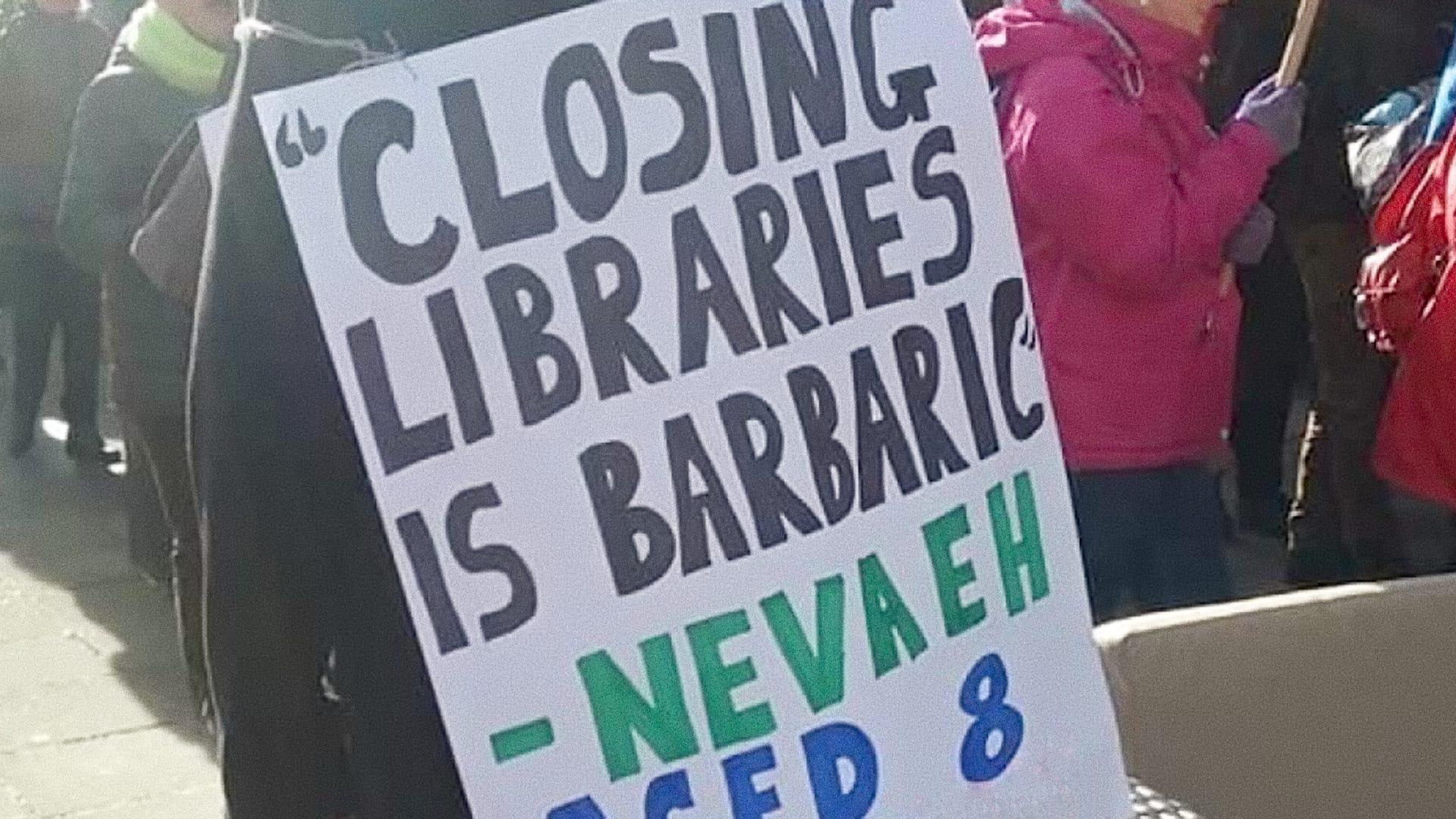
Through a bold range of tactics, we reached out to people to explain what was happening and ask them to join us. We flipped the council consultation which unhelpfully asked ‘Would you rather have social care or libraries?’ and instead asked people what their dream library would be (using a dream jar inspired by the BFG). We held a carnival for libraries: chants of ‘Having fun isn’t hard if you’ve got a library card!’ We attended council meetings and asked questions. An eight-year-old spoke at our public meeting. She said: ‘Closing libraries is barbaric’. She’d learned that word from a book from the library. Every time I went somewhere to speak about the campaign, I held her in my head – if she can do it, so can I.
My town is often described as apathetic. Turnout at local elections is around 20%. With the impacts of austerity, people have seen the town run down and felt powerless. We needed to get people involved and to feel like they had a stake in their local area. When organisers across the county came together to submit 30,000+ signatures to the council, over 6,000 of them were from my ‘apathetic’ town. I put that down to a lot of hard work and that people are not apathetic at all, but need the opportunity to get involved, feel their power and know their voice means something.
When organising to save my local music venue, I was asked to do things. In this campaign I was part of the team making the asks. It brought me together with a group of people who had been organising for years and, my goodness, I learned so much from them about doggedness, finding joy, and taking on the council in unexpected ways (like sitting in the council chamber silently holding up library books). They could easily have told me that they knew everything about organising and told me what to do, but we always worked together. We were publicly and effectively holding decision-makers to account rather than hoping they would take action themselves.
I also learned that organising can be all-consuming. While I’m sure this doesn’t linger in my daughter’s memories and hasn’t stunted her emotional growth, this campaign impacted my life in all areas. I spent far too much time distractedly researching on my phone or waiting to see if there had been a response to a press release, when I could have been playing with her. I remember staying up until 1am writing a report and collating evidence, and I would have been up and grumpy not too long after with her. I’d like to say it was worth it. Ultimately, I was organising for her and her community’s future, and maintaining that balance is hard.
Following the win, the campaign was heavily involved with a major independent research report conducted by University of Essex's Human Rights Centre. The summary of research was officially submitted to the UN to assist in a review of poverty and social rights in the UK.
This was the best organising experience I have ever had, and brought to life this Margaret Mead quote for me: ‘Never doubt that a small group of thoughtful, committed citizens can change the world. Indeed, it is the only thing that ever has.’ There was not one paid organiser involved, it was entirely grassroots. We didn’t talk about organising theory or who had it right. We shared our resources and experience and won. And what we did was covered by the UN! How amazing is that?
Grassroots versus professional organising
At this point, I hadn’t heard of ‘community organising’. I knew about organising in the workplace and the role of unions, but I hadn’t thought of there being a name for it in a community, let alone it being a paid job, with lots of theorists in the field. I got on the bike, got knocked down, got back on again, and learned to do a few tricks on it. I feel one of my main strengths as an organiser is my authenticity (combined with the people I have found). For myself, I am glad I was able to find myself as an organiser before I found the theory which would develop my practice.
Following the success of the campaign to save the library, I started my first paid organiser role at a local foodbank, where I set up an organising group to bring people together to take action on the issues they were facing. Last year, we took on a landlord who was penalising residents with terrible housing conditions and threatening to increase their rent. Bringing 16 residents together, we power-mapped and built relationships with the press, local councillors and the MP. When the building was eventually deemed unsafe, 52 residents were given 12 hours to leave with the landlord suggesting they move to properties two to three hours away. The groundwork we had laid meant press coverage was easy to achieve and put real pressure on the council to act. Thanks to our organising, every single person was able to stay in the town where they had put down roots and built a support network.
Bringing care into my praxis
Everything I’ve learned through these different campaigns has influenced my organising work. And it’s an ongoing process. I’ll always wish that I had done more to support my own care and wellbeing through it – but a part of me felt that was selfish, as I wasn’t experiencing the crisis myself. But how can I continue to organise if I am burned out?
An ongoing thread for me throughout my organising has been that I need stronger boundaries – and to be honest, I’m still working on that. When working with people in crisis, there is no, ‘it’s 5pm, I’ve finished work, that’s out of my mind’. I will forever be emotionally invested. I hadn’t even thought of care in organising until I came to Act Build Change.
I know that I have grown and developed as an organiser a lot in the past ten years. I have been lucky enough to be surrounded by people who have shared their time and experience. Where once I deferred to authority as with my local music venue, I can’t imagine asking permission in grassroots organising now.
My brain responds to stories – perhaps that’s why music and libraries mean so much to me. Often, after sessions, I have written out what happened, my role in events, what went well and what could have been better, and what I learned. Once it’s out, it is also like the event exists separately to me. It’s a processing tool that many will be aware of, but I don’t think organisers always utilise enough. You have to look after yourself.
For me, organising is all about balance, and constant reflection, finding the joy where you can and holding fast to your values - and, unless you are organising to create your own appreciation society, knowing it’s not about you. Create those relationships. You can learn from the people who have paved the way and done things before, but the best thing I ever did was get doing. Get on your bike. You might be surprised where it will take you.