Voices
Why Green New Deal Rising are Changing Strategy to Sustain a Movement
Billy Wassell shares why Green New Deal Rising are taking a new approach to electoral campaigning.
Billy Wassell | 28 Sep 2026
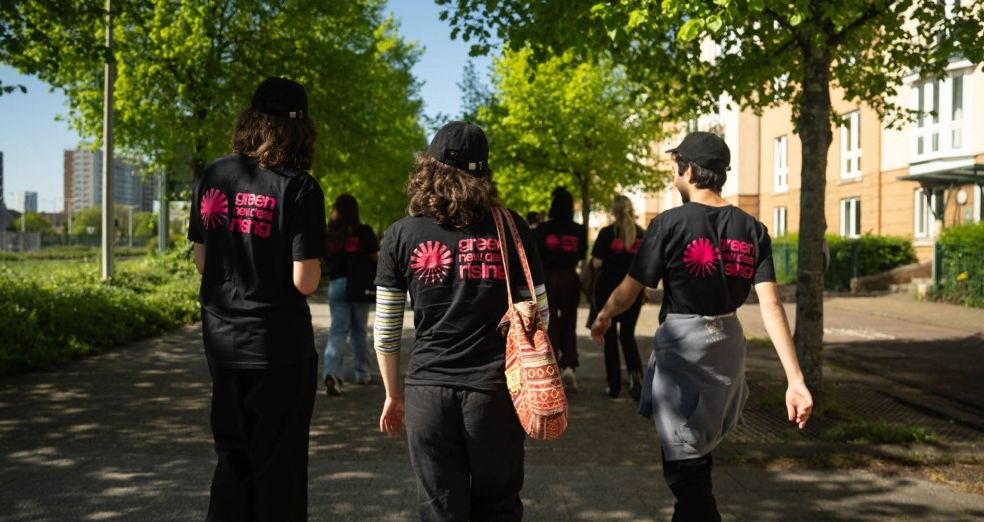
How can we turn the energy from election campaigns into sustained community power? That’s the question we’re asking ourselves at Green New Deal Rising as we move into a new era of our campaigning work.
Green New Deal Rising (GNDR) is a youth-led, grassroots organisation fighting for climate and social justice. We fight for a world where everyone can thrive which means implementing a Green New Deal – a radical plan to transform our economy to benefit working people and to tackle the climate crisis at the speed and scale that is needed.
We see elections as a huge opportunity to harness and develop our organisation’s power and leverage. The national and local elections in May 2026 across Britain were no different. We aimed not only to mobilise a high turnout of young people to both canvas and vote for progressive candidates (our business as usual), but also to develop their leadership and bring them into the movement to build lasting power.
Why we are taking a new approach
Since the beginning of GNDR, our movement capacity has tended to peak and trough – people have joined during periods of intense activity (e.g. elections, high-profile actions) but then dropped away when the moment is over, or the short-term goal has been achieved. People come and go and our core organiser team has to rebuild capacity over and over. This puts quite the strain on both the small staff team and the team of core organisers. Staff and reliable volunteers are naturally picking up the extra capacity – much to their detriment, both physically and mentally. This reality has become unsustainable if we are to build a long-term movement with genuine people-power.
When mobilising, we can sometimes treat people as a resource to be used towards our aim without investing in the individual. It could be argued that we have been guilty of that at GNDR in the past, too. Clearly, something needed to change. That’s why we approached the 2026 national and local elections differently.
Instead of mobilising young people around electoral events and hoping they stick around, we designed the electoral moment around relational infrastructure. We wanted to shift our strategy so that it created stronger elements of relational organising – building power through nurturing strong relationships – and local decision-making, rather than relying on moments of mobilisation. It will take time to get it right, but this is how we are starting the process.
Building the relational infrastructure
To mobilise our movement during the national and local elections in May, we developed an online tool called MyElectionMap.co.uk (MEM). Similar to MyNearestMarginal, an online tool used to direct people to their nearest marginal seat in the 2017 general election, users type in their postcode and the nearest campaigning events for progressive champions in their area would show up. As well as showing in-person spaces where users of MEM could meet up and campaign together, it directed people to online relational entry points such as welcome calls, online canvassing training, and organiser calls. From there, they would meet people already involved in our movement, learn more about the workings of our organisation and join their local team. This infrastructure was the first step in developing people as longer term campaigners.
Nina, one of our Cardiff team leaders, joined us as a volunteer through MEM. ‘I would not have been nearly as involved with the Senedd elections if it wasn’t for GNDR,’ she said, ‘MEM showed events every week and it meant I knew I was going to see a friendly face each time.’ This wasn’t an accident, we designed MEM to push people towards our relational infrastructure. The relationships built over multiple canvassing events were crucial to keeping people involved and active, rather than dropping off the radar.
Our Spring Gathering
Every year GNDR runs a Summer Gathering – an event that brings our whole movement together, in-person, for a weekend of training, strategising, and organising. Our gatherings act as both an entry point for new members wanting to dip their toe in but also a re-energiser for people already involved. This year, we decided to run a gathering in the spring. It was the organisation’s first time putting real resources into organising in Cymru. With a new staff organiser there, as well as a growing local team and an important national election coming up, Cardiff felt the natural place to host our first Spring Gathering.
Traditionally, our Summer Gatherings are mainly staff-led – they will plan and facilitate almost all of the sessions. We could’ve followed that model for our Spring Gathering. Instead, we used it to further develop the leadership of our volunteers in Cardiff.
During the gathering, volunteers co-facilitated sessions, answered questions from other attendees, provided local political context and led small groups of canvassers. The Spring Gathering was a barometer for how well MEM was at opening the door to new members but also how effective our relational infrastructure was at nurturing new people and keeping them involved in our work.
The incorporation of our core Cardiff volunteers was a deliberate decision. With the Cardiff team stepping up like this, the rest of our movement learned that they could also do that. Attendees were no longer watching ‘experts’ (staff), they were learning from their peers. Platforming volunteer leaders in this way is integral to further leadership development. It not only gives existing leaders another opportunity to showcase their qualities but, more importantly, it shifts the mindset of attendees who may have struggled to see themselves as leaders previously. Our Spring Gathering wasn’t just about making an impact on a national election, it was about showing people they belonged in leadership roles within our movement.
Investing in leadership
Before the main election campaign in Cymru, our local team in Cardiff was meeting towards the end of 2025 with three to four people attending monthly meetings. By the summer of 2026, the core team had doubled. The Cardiff team has grown to as large as twenty active members. Many of the candidates we were supporting won in their constituencies. But another, often less talked about win, is that the young people who joined us didn’t just scatter once the polls closed – the infrastructure that we built meant they continued to organise and grow as leaders.
Nina was a volunteer who was quickly identified as a potential leader. Through coaching and one-to-ones with our staff Cymru Organiser Gwynfor, Nina progressed into a local team leader role. When the Spring Gathering came round, Nina contributed to session facilitation and was an expert on the ground who shared knowledge and insight, coaching others on electoral organising skills. Her leading voice in the movement was spotlighted when her challenge of Nigel Farage went viral.
Post-election, Nina is now a lead organiser in Cardiff and a convenor of the monthly local team meetings, where the local team is building momentum through the Jobs for our Future campaign. They’re currently in a cycle of Act, Recruit, Train to build local capacity and to put pressure on elected officials to fix the youth unemployment crisis. Nina is steering the local group – delegating tasks, ensuring progress is being made and supporting the development of other leaders in the group. Nina’s and the Cardiff group’s work will culminate in a November Youth Summit at the Senedd where they will take their demands directly to politicians of all parties.
Lessons from relational organising
Our electoral organising in May 2026 came with a lot of lessons learned. The first is about trusting people to step up when given what may be perceived as a ‘high bar’ ask. Our Spring Gathering was a very successful event with higher turnout and interest than expected. Hosting it in a place where we had invested more broadly in movement-building meant we got lots of locals attending, and the excitement of the moment resonated with people. The Gathering was also effective at getting attendees involved in further canvassing efforts particularly on polling day. All this is to say, do not restrict the ambitions of your people: think bigger, bolder and riskier – they will not disappoint.
Our electoral organising in this period has also demonstrated the importance of trusting local knowledge and understanding rather than imposing national approaches. Effective electoral campaigns require stepping back and allowing local organisers and volunteers the autonomy to act based on their deep knowledge of their communities. Those on the ground understand the specific political landscape, community dynamics, and local contexts in ways that centralised staff cannot. By relinquishing the impulse to control implementation and instead placing trust in local expertise, we can achieve more authentic engagement and ultimately stronger results that are genuinely rooted in local realities.
Finally, lasting relationships between young people and elected politicians can happen when we genuinely invest in those relationships. Through the 2026 election campaign, young people developed meaningful relationships with political figures – both with those who won and those who didn’t. These relationships created a strong local foundation that extends well beyond any single election cycle and are becoming a lasting resource. Young people have an ongoing dialogue with the politicians they have canvassed for, and with candidates who did not win they are able to continue developing relationships so the constituency is stronger next time around. Effective electoral organising serves not only its immediate purpose but also cultivates deeper, ongoing political engagement and democratic participation among young people.
The elections may have been a key entry point for many in our movement, but it’s the relationships we have invested in that will continue to make a difference in our campaigns going forwards. Now, we’re focussing on building our movement and making climate one of the most important issues to voters. We’re doing this through our Jobs for our Future campaign where our local teams are organising to build capacity and apply pressure on local MPs, MSs and MSPs to accept the demands of our campaign.